

Description
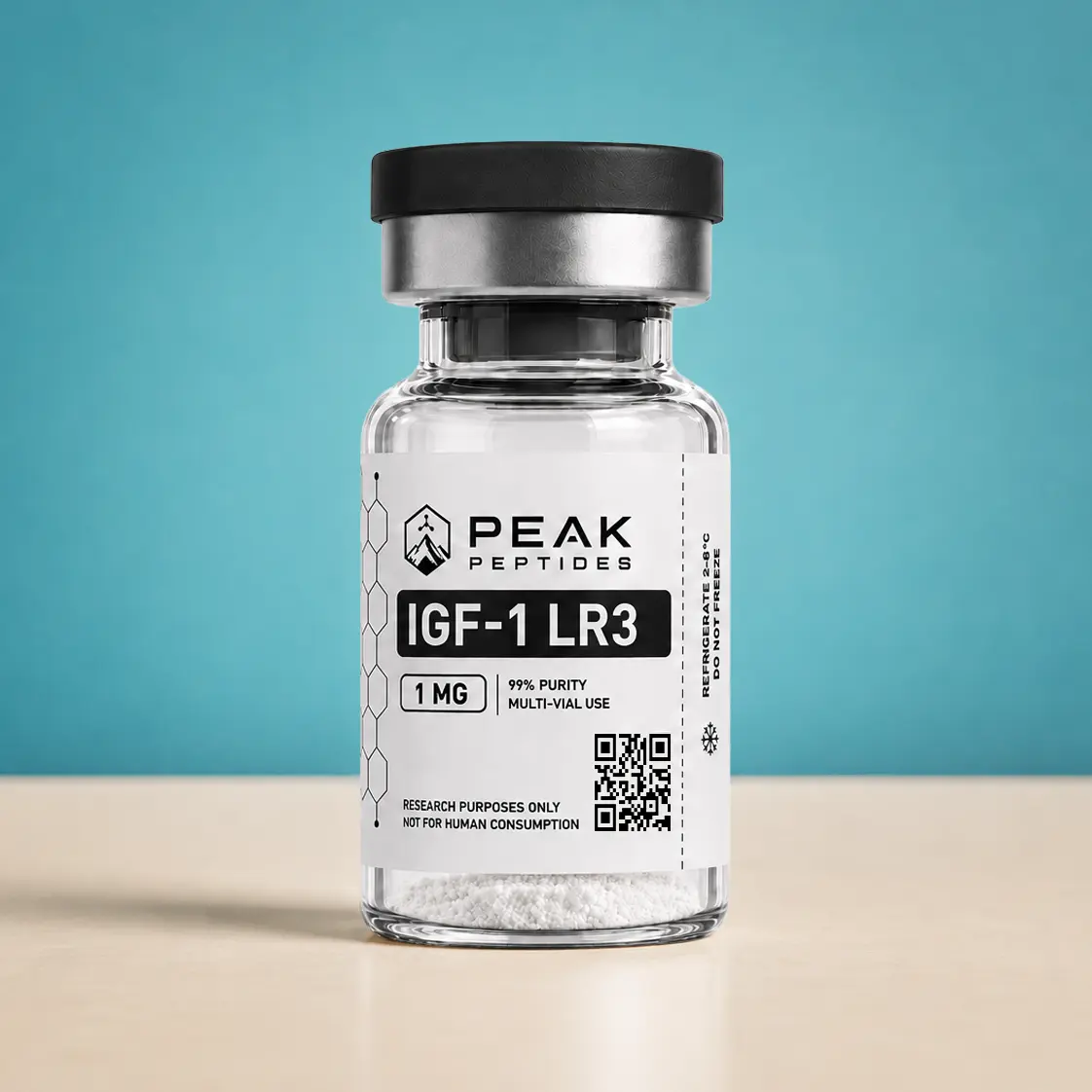
IGF-1 LR3 1mg Research Material
IGF-1 LR3 1mg is a synthetic analogue of insulin-like growth factor-1 (IGF-1) supplied as a defined research material for controlled laboratory and analytical investigation of IGF-associated signaling and growth-factor biology.
IGF-1 LR3 differs structurally from native IGF-1 through an arginine substitution at position three and a 13-amino-acid N-terminal extension, producing a peptide consisting of 83 amino acids. These modifications are important to its use as a comparative research analogue.
The modified structure has generated scientific interest in ligand-receptor interactions, IGF-binding-protein affinity, intracellular signaling, peptide engineering, and the relationship between molecular structure and growth-factor activity in experimental systems.
Compound: IGF-1 LR3
Research Quantity: 1mg
Research Classification: Synthetic IGF-1 Analogue
Primary Molecular Target: IGF-1 Receptor (IGF1R)
Research Focus: IGF-1 receptor signaling, growth-factor biology, ligand-receptor interactions, peptide engineering, and intracellular signaling pathways
IGF-1 Receptor Research
The IGF-1 receptor is a receptor tyrosine kinase that participates in complex intracellular signaling networks. Ligand binding initiates receptor phosphorylation and downstream molecular events, making the IGF system an important model for studying growth-factor signaling and receptor-mediated cellular responses.
IGF-1-associated research commonly examines pathways including PI3K-AKT and MAPK signaling, alongside broader questions involving receptor activation, protein synthesis, cellular proliferation, differentiation, and molecular-response mechanisms in experimental models.
IGF-1 LR3 1mg provides a defined research format for investigating IGF-1 receptor signaling, ligand-receptor interactions, intracellular signaling pathways, comparative growth-factor behavior, and relationships between peptide modification and molecular activity.
Why IGF-1 LR3 Is Scientifically Interesting
IGF-1 LR3 is particularly interesting from a peptide-engineering perspective because relatively specific structural changes distinguish it from native IGF-1. This allows comparative investigation into how sequence modification can influence molecular interactions and peptide behavior.
A key area of research concerns its altered interaction with IGF-binding proteins (IGFBPs). These proteins normally participate in regulating the distribution and availability of endogenous IGFs, making differences in binding affinity an important variable in comparative laboratory studies.
IGF-1 LR3 consequently provides a useful experimental model for studying growth-factor signaling, receptor pharmacology, protein interactions, molecular modification, and structure-activity relationships.
Research Applications
IGF-1 LR3 1mg may serve as a research material within appropriately designed laboratory studies examining IGF-1 receptor biology, growth-factor signaling, IGF-binding-protein interactions, intracellular signaling, comparative peptide analysis, and structure-activity relationships.
Experimental interpretation should account for factors including assay design, experimental model, receptor expression, material characterization, laboratory conditions, and analytical methodology.
This material is offered exclusively for laboratory, analytical, and scientific research purposes. Product information is provided for compound identification and scientific reference only and does not constitute medical, therapeutic, diagnostic, or administration information.