

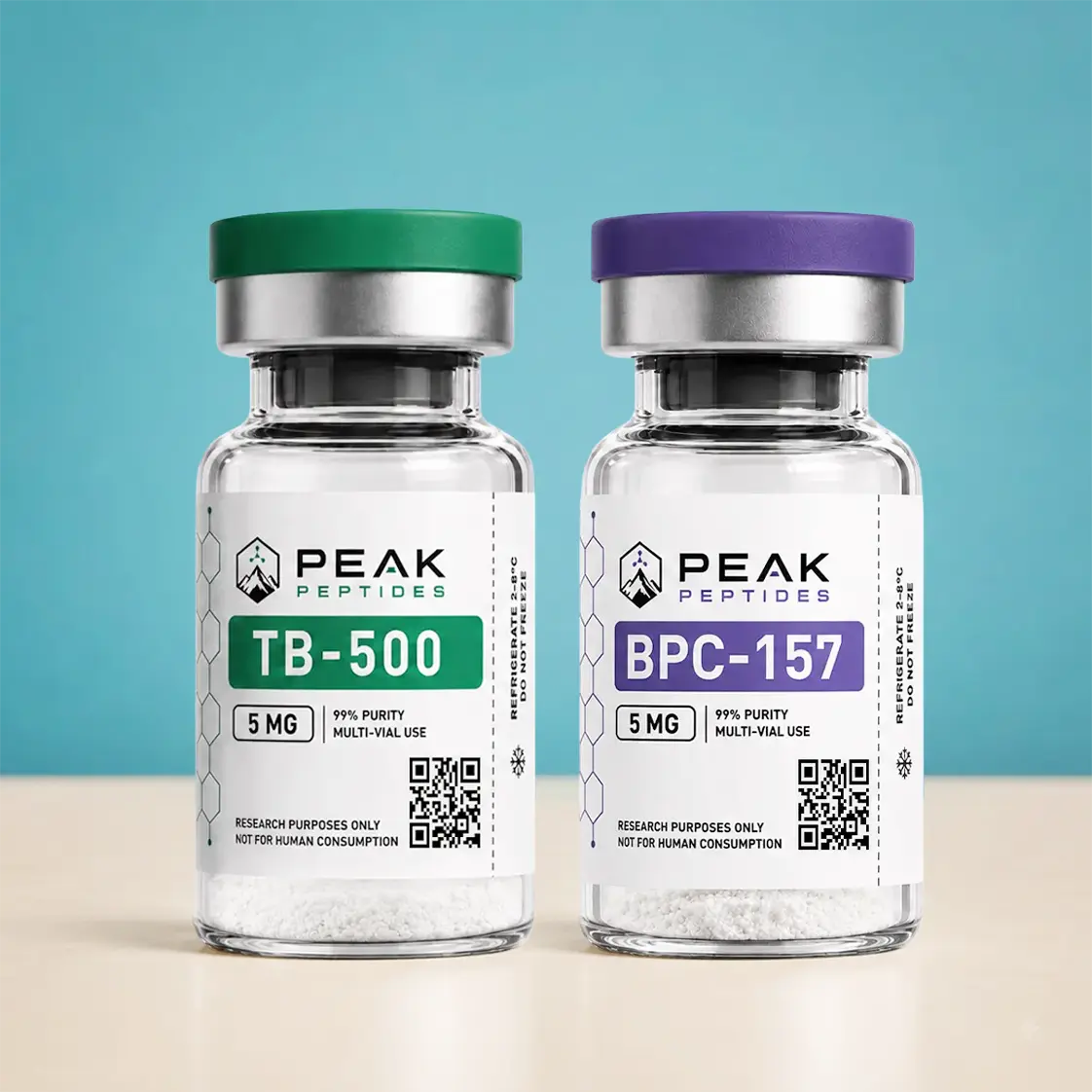

Description
Wolverine Peptide Programme
The Wolverine Peptide Programme combines BPC-157 5mg and TB-500 5mg in a defined research format designed for laboratory and analytical investigation of two distinct peptide-associated molecular systems.
BPC-157 is a synthetic 15-amino-acid peptide investigated primarily in preclinical models involving cellular signaling, angiogenesis-associated pathways, nitric-oxide-related mechanisms, cellular migration, and tissue-associated molecular responses.
TB-500 is associated with thymosin beta-4 research and actin-related cellular processes. This research area includes cytoskeletal organization, cellular migration, actin dynamics, angiogenesis models, and molecular mechanisms associated with cellular remodeling.
Programme: Wolverine Peptide Programme
Compound 1: BPC-157 — 5mg
Compound 2: TB-500 — 5mg
Total Research Material: 10mg
Research Classification: Dual-Peptide Research Format
Research Focus: Cellular signaling, actin dynamics, cytoskeletal organization, cellular migration, angiogenesis-associated pathways, and experimental tissue-model research
Dual-Pathway Peptide Research
The scientific interest surrounding this research format originates from the distinct molecular systems associated with BPC-157 and TB-500. Rather than representing a single peptide, the programme provides two separate compounds for comparative and multi-pathway laboratory investigation.
BPC-157 research has examined vascular signaling, nitric-oxide-associated mechanisms, cellular migration, growth-factor-associated pathways, and experimental tissue responses. These investigations remain predominantly preclinical and continue to be explored at the molecular level.
TB-500-related research focuses on a different molecular area, with particular scientific interest in actin-associated pathways, cytoskeletal dynamics, cellular migration, and cellular organization.
The Wolverine Peptide Programme provides BPC-157 5mg and TB-500 5mg in a defined dual-compound research format for investigating distinct peptide-associated pathways involving cellular signaling, actin regulation, cellular migration, angiogenesis models, cytoskeletal organization, and molecular-response mechanisms.
Why This Combination Is Scientifically Interesting
The primary scientific interest in studying BPC-157 and TB-500 within the same research framework is their association with different molecular mechanisms. This allows researchers to investigate separate but potentially intersecting areas of cellular and molecular biology.
BPC-157 provides a model for studying peptide-associated signaling, vascular-response mechanisms, nitric-oxide-related pathways, and cellular migration, while TB-500-related research provides a framework for examining actin regulation, cytoskeletal organization, and cellular motility.
Because controlled research specifically evaluating the combined BPC-157 and TB-500 format remains limited, the interaction between these research compounds represents an area requiring further experimental characterization rather than an established synergistic mechanism.
Research Applications
The Wolverine Peptide Programme may serve as a dual-compound research format within appropriately designed laboratory studies investigating cellular signaling, actin-associated pathways, cytoskeletal dynamics, cellular migration, angiogenesis models, peptide interactions, and comparative molecular-response mechanisms.
Experimental interpretation should distinguish observations associated with each individual compound from observations involving the combined research format and should account for assay design, experimental model, material characterization, peptide stability, laboratory conditions, and analytical methodology.
This programme contains BPC-157 and TB-500 research materials and is offered exclusively for laboratory, analytical, and scientific research purposes. Product information is provided for compound identification and scientific reference only and does not constitute medical, therapeutic, diagnostic, or administration information.