


Description
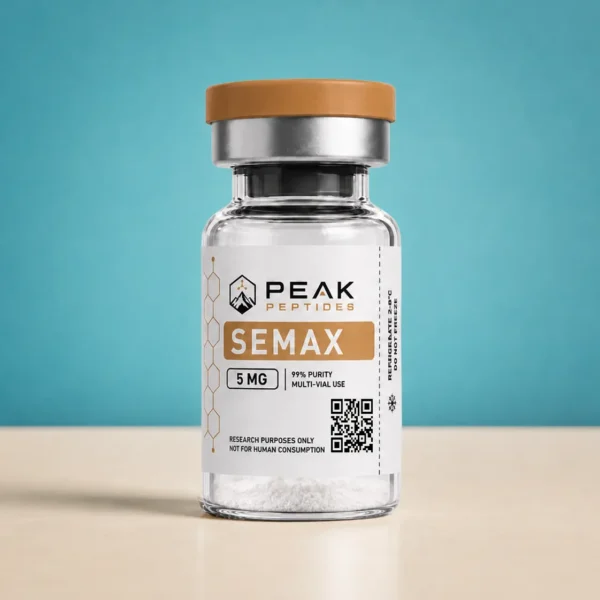
Semax 10mg Research Material
Semax 10mg is a synthetic heptapeptide derived from an adrenocorticotropic hormone (ACTH)-related sequence. It is supplied as a defined research material for controlled laboratory and analytical investigation of neuropeptide signaling, molecular-response pathways, and peptide structure-function relationships.
Semax corresponds to the amino-acid sequence Met-Glu-His-Phe-Pro-Gly-Pro and was developed from research involving the ACTH(4–7) fragment. The addition of the Pro-Gly-Pro sequence distinguishes Semax structurally and has contributed to scientific interest in its stability and molecular behavior.
Laboratory research involving Semax has explored neurotrophic signaling, gene-expression changes, peptide-mediated cellular responses, and interactions among molecular pathways associated with experimental neural models.
Compound: Semax
Research Quantity: 10mg
Research Classification: Synthetic ACTH-Related Heptapeptide
Peptide Sequence: Met-Glu-His-Phe-Pro-Gly-Pro
Research Focus: Neuropeptide signaling, neurotrophic pathways, gene expression, peptide stability, and molecular-response research
Neuropeptide Signaling Research
Neuropeptides represent an important class of signaling molecules used to investigate communication between cellular pathways and changes in molecular activity. Semax provides an interesting experimental model because its relatively compact peptide structure is associated with a diverse range of reported molecular responses in laboratory systems.
Experimental studies involving Semax have investigated neurotrophic-factor-associated signaling, transcriptional responses, peptide-regulated gene expression, and molecular pathways associated with neural cell models. These areas remain subjects of continuing biochemical and molecular research.
Semax 10mg provides a defined research format for investigating neuropeptide signaling, gene-expression pathways, neurotrophic-factor-associated responses, peptide stability, and relationships between peptide structure and molecular activity in experimental systems.
Why Semax Is Scientifically Interesting
Semax is scientifically interesting because it illustrates how modification of a relatively short peptide sequence can produce molecular characteristics distinct from those of the parent peptide fragment. This makes it useful for studying relationships between peptide architecture and biochemical response.
Research has examined relationships involving peptide stability, transcriptional activity, neurotrophic signaling pathways, cellular-response mechanisms, and structure-activity relationships. Such investigations can help characterize how short synthetic peptides interact with complex biological signaling networks.
Semax is consequently relevant to broader research involving peptide chemistry, molecular signaling, experimental neuroscience, and comparative analysis of synthetic peptide analogues.
Research Applications
Semax 10mg may serve as a research material within appropriately designed laboratory studies investigating neuropeptide signaling, peptide structure-function relationships, gene-expression pathways, neurotrophic signaling, comparative peptide analysis, and molecular-response mechanisms.
Experimental interpretation should account for factors including assay design, experimental model, material characterization, peptide stability, laboratory conditions, and analytical methodology.
This material is offered exclusively for laboratory, analytical, and scientific research purposes. Product information is provided for compound identification and scientific reference only and does not constitute medical, therapeutic, diagnostic, or administration information.